- Learning Japanese
- Japanese Culture
2025.12.28

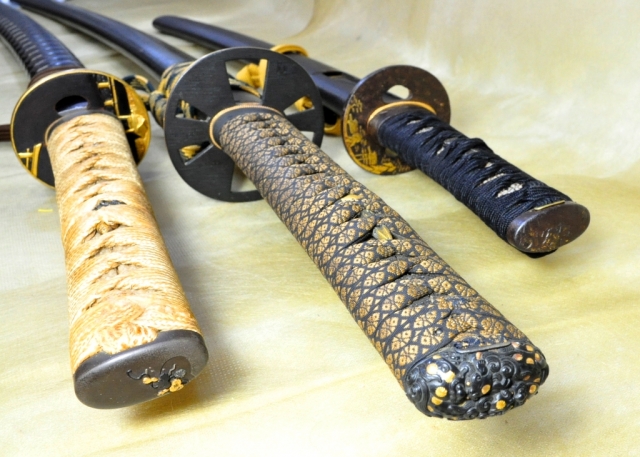
Those who have developed an interest in samurai through dramas or games may wonder,
“What kind of swords did Japanese samurai actually use?”
In this article, we will introduce the seven types of Japanese swords, the names of the parts that make up a Japanese sword, and the masterpieces of Japanese swords known as the “Tenka Goken (天下五剣)”.
We will also explain the history of Japanese swords, so please use this article as a reference.

Before the Nara period, Japanese swords were straight rather than curved, and did not yet have the distinctive curvature seen in later Japanese swords.
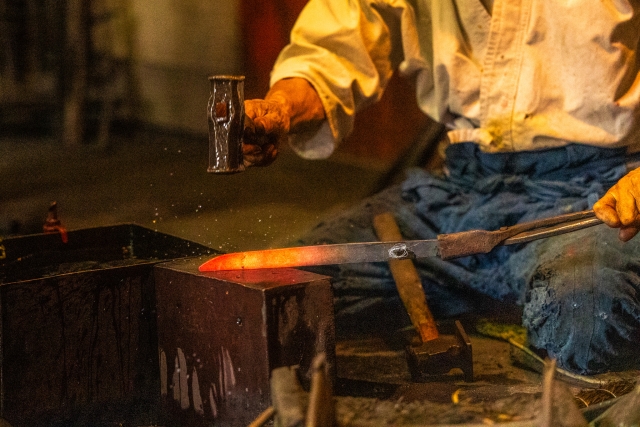
However, as time passed and by the mid-Heian period, with the appearance of samurai and the development of forging techniques, swords evolved into curved blades called wantō (湾刀)— designed for easier drawing and cutting while on horseback, making them more practical for real combat.
As battles grew larger and the power of the samurai expanded, the demand for Japanese swords increased rapidly. This led to the establishment of the five major sword-making traditions, known as Gokaden (五箇伝): the Yamato-den, Yamashiro-den, Bizen-den, Sōshū-den, and Mino-den, each producing swords with its own distinctive characteristics.
On the other hand, during the Edo period, as large-scale battles ceased to occur, many swordsmith workshops declined and Japanese sword production went into decline.
However, by the late Edo period, famines and deteriorating public security led to renewed attention to Japanese swords.
Then, after the Meiji Restoration, the government issued the Haitōrei (廃刀令), a law that prohibited the carrying of swords. As a result, Japanese swords came to be preserved as family heirlooms handed down from generation to generation.
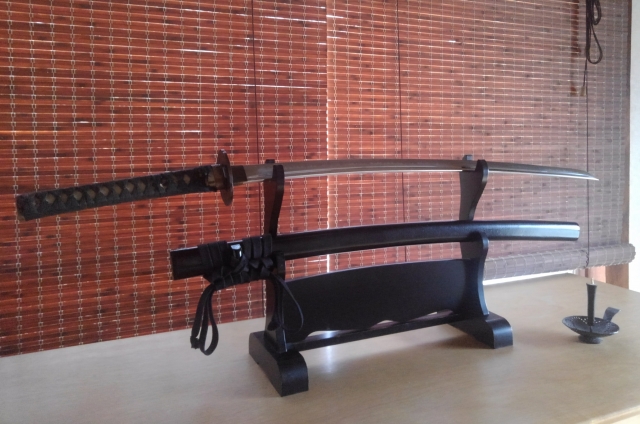
What kinds of Japanese swords were used by samurai,
who made their living through martial skill and combat?
There are seven main types of Japanese swords:
Below, we will explain the characteristics of these seven types of Japanese swords,
as well as examples of which historical figures owned them.
The chokutō is a Japanese sword said to have been used from the late Kofun period to the mid-Heian period. It represents the type of sword used before the adoption of the curved wantō style.
Although ancient, the chokutō was already forged using the orikaeshi-tanren (folded forging) method, a traditional technique that continues to define Japanese swordmaking today.
As its name suggests, the chokutō has a straight or slightly inward-curved blade, and was used more for striking or thrusting rather than for cutting.
Beyond the battlefield, chokutō were often elaborately decorated and valued as ceremonial or presentation swords by those in power.
One famous example is the Kokushitsuken (黒漆剣), said to have been dedicated by the Heian-period general Sakanoue no Tamuramaro to Kurama-dera Temple in Kyoto.
The tachi is believed to have originated in the late Heian period and was a large sword designed for use on horseback, with a blade length of about 70 to 75 cm or more.
Unlike the chokutō, the tachi has a graceful curvature, making it easier to draw while mounted and better suited for cutting downward from horseback. For that reason, it remained favored through the Nanbokuchō period, when mounted combat was still common.
A distinguishing feature of the tachi is that it was worn edge-down, suspended from the waist by cords, so it could be drawn swiftly in battle.
Ashikaga Yoshiteru, the 13th shogun of the Muromachi shogunate, who mastered swordsmanship under Tsukahara Bokuden, is said to have cherished a tachi made by Motochika.
Famous tachi also include the Tsuda Tōtōmi Nagamitsu (津田遠江長光), used by Oda Nobunaga, and the Nikkō Sukezane (日光助真), the beloved sword of Tokugawa Ieyasu.
The uchigatana was a Japanese sword used mainly for ground combat and individual duels, and it was widely used from the Muromachi through the Edo period.
With a blade length of about 60–70 cm, it was shorter and lighter than the tachi, making it easier to handle in close combat. As warfare shifted from cavalry to infantry battles in the Muromachi period— due to the rise of firearms— the uchigatana became the preferred weapon.
During the peaceful Edo period, it remained an important symbol of the samurai class,
commonly worn at the left side of the waist with the edge facing upward.
In period dramas, manga, and games, the sword that samurai are often shown wearing is the uchigatana.
Famous uchigatana include Heshikiri Hasebe (へし切長谷部), owned by Oda Nobunaga and Kuroda Kanbei, the Unnamed Sword (伝安綱 / Den Yasutsuna), owned by Toyotomi Hideyoshi, and Izumi no Kami Kanesada (和泉守兼定), the beloved sword of Hijikata Toshizō.
The wakizashi is a shorter Japanese sword commonly used during the Edo period,
typically worn together with an uchigatana in what was called “two-sword style” (二本差し).
Although shorter swords had existed as personal defense weapons since the Heian and Kamakura periods, the Edo-era law Buke Shohatto (武家諸法度) encouraged samurai to wear both long and short swords, and the wakizashi thus became an important symbol of samurai honor.
Even commoners such as townspeople and farmers were allowed to carry wakizashi for self-defense, and some did so as a precaution against possible unjust treatment by samurai.
Famous examples include Honebami Tōshirō (骨喰藤四郎), owned by Minamoto no Yoritomo, and Nikkari Aoe (ニッカリ青江), owned by Niwa Nagahide.
The tantō is a Japanese sword with a blade length of about 30 cm or less, having little or no curvature.
From the Kamakura to the Muromachi period, it was used to take the heads of defeated enemies, and during the Edo period, it was carried by women of samurai families as a weapon for self-defense.
In samurai households, it was also customary to gift a tantō called a mamorigatana (守り刀) to protect the child when one was born.
Famous tantō include Aizen Kunitoshi (愛染国俊), owned by Toyotomi Hideyoshi and Tokugawa Iemitsu, and Atsu Tōshirō (厚藤四郎), passed down within the Ashikaga shogunal family.
The naginata is a pole weapon with a curved blade mounted on a long shaft, well suited for sweeping and cutting movements. It was widely used from the Heian to the Nanbokuchō period.
However, in the Sengoku period, as large-scale group battles became the norm, accidents occurred in which soldiers injured allies while swinging naginata, and its battlefield use gradually declined.
In the Edo period, however, naginatajutsu became known as an art taught to daughters of samurai families as part of their education. Even today, the naginata is often regarded as a weapon associated with women in Japan.
A famous example is the Iwatōshi (岩融), said to have been owned by the warrior monk Benkei.
The yari is a spear with a pointed blade mounted on a long shaft, specialized for thrusting attacks.
In the Sengoku period, because naginata were dangerous to use in close formations, the yari replaced them as the primary weapon on the battlefield.
It was also valued for being simple enough for even untrained foot soldiers (ashigaru) to handle effectively. Large groups of spearmen would line up shoulder to shoulder to form a yaribusuma (槍衾), a “wall of spears” used to defend against cavalry charges.
Among spears, the ōmi-yari (大身槍) had particularly long and heavy blades, and could only be handled by warriors of great strength. The spear known as Tombokiri (蜻蛉切), used by Honda Tadakatsu, had a blade length of 43.7 cm and a total shaft length of about 312.1 cm.
★Also try reading:
12 of the Most Famous Samurai in Japanese History | Introducing Legendary Swordsmen and Warlords
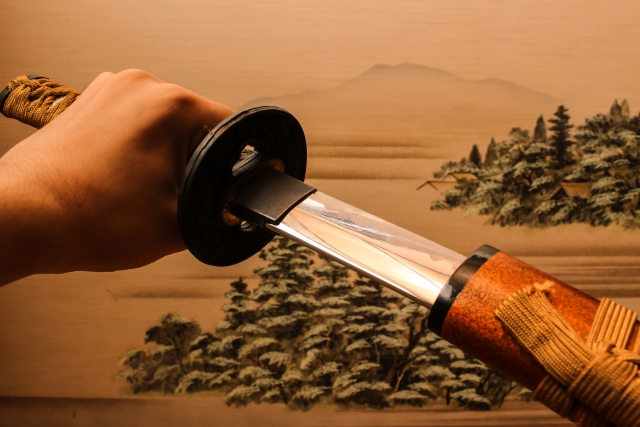
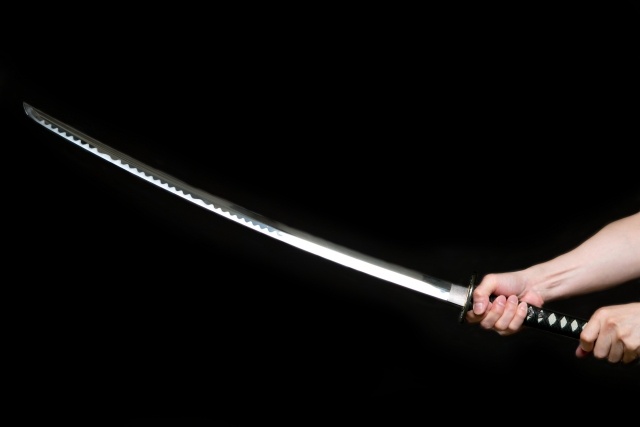
The parts that make up a samurai’s Japanese sword include the following:
|
Kissaki (切先) |
the tip of the blade, considered the most beautiful part. |
|
Ha (刃) |
the entire cutting edge of the sword. |
|
Hasaki (刃先) |
the very edge that cuts the target. |
|
Monouchi (物打) |
about 9 cm below the tip; the strongest, sharpest part of the blade. |
|
Mine (峰) |
the back edge opposite the cutting edge. |
|
Shinogi (鎬) |
the ridge line running along the side of the blade. |
|
Habaki (鎺) |
the metal collar fitted between the blade and guard to secure the blade in the scabbard. |
|
Nakago (茎) |
the tang of the blade, covered by the handle, which the user grips. |
|
Mekugi-ana (目釘穴) |
a hole used to secure the tang to the handle. |
|
Mekugi (目釘) |
a peg inserted through the hole to fix the tang in place. |
|
Tsuka (柄) |
the handle held when using the sword. |
|
Tsuka-gashira (柄頭) |
a metal fitting reinforcing the end of the handle. |
|
Saya (鞘) |
the scabbard that encases and protects the blade. |
|
Koiguchi (鯉口) |
the mouth of the scabbard, where it meets the guard. |
|
Tsuba (鍔) |
the circular guard preventing the hand from slipping onto the blade. |
Among the masterpieces of Japanese swords, the following five are known as the “Tenka Goken” (Five Greatest Swords Under Heaven):
|
Ōdenta Mitsuyo (大典太光世) |
A sword believed to possess spiritual power. When Maeda Toshiie’s daughter Gō-hime fell ill, Toyotomi Hideyoshi lent her this sword to place at her pillow, and it is said her illness was instantly cured— only to return when the sword was returned. |
|
Onimaru Kunitsuna (鬼丸国綱) |
Hōjō Tokiyori, the 5th regent of the Kamakura shogunate,was tormented by dreams of a demon each night.One night, this sword is said to have fallen over by itself and cut off a decorative piece of his brazier that resembled the demon from his dreams— after which the nightmares ceased. |
|
Juzumaru Tsunetsugu (数珠丸恒次) |
A sword given to Nichiren, founder of the Nichiren sect, during the Kamakura period. Known as the “Sword of Expelling Evil and Revealing Truth,” it symbolized striking down falsehood and spreading true Buddhist teachings. |
|
Dōjigiri Yasutsuna (童子切安綱) |
Named after the legend of Minamoto no Yorimitsu, who used it to slay the demon Shuten Dōji during the Heian period. This sword was later handed down through the Ashikaga, Toyotomi, and Tokugawa families. |
|
Mikazuki Munechika (三日月宗近) |
Recognized as the most beautiful of the Five Swords Under Heaven, it has crescent moon patterns (mikazuki) along its blade. Forged by Sanjō Munechika, one of the three greatest swordsmiths of Japan, who also made famous swords such as Benkei’s Iwatōshi. |
Some of the Tenka Goken are exhibited at the Tokyo National Museum, so if you are interested, check the exhibition schedule and consider visiting Japan to see them.
★Also try reading:
11 Essential Books to Understand Japanese History – A Guide for Western Readers
In this article, we introduced the seven types of Japanese swords, the names of their parts, and the masterpieces known as the “Tenka Goken.”
If you love Japanese history and culture and would like to learn the Japanese language as well, why not start online lessons with Oku Sensei’s Japanese?
At Oku Sensei’s Japanese, even beginners can aim to acquire practical Japanese,
with full support from a teacher who has over 20 years of experience in education.
Currently, Oku Sensei’s Japanese is offering a 30-minute free consultation, so please check it out!